




Free Range Egg Producers Special: Are you fed up?
For more information on free range egg production visit www.theranger.co.uk
Very occasionally a feed mill may make a mistake. This is not knock the mill time, because it is impressive how load after load, the feed quality invariably matches the specifications / formulae. Nevertheless mistakes can occasionally happen and this may make a big dent in your egg production, egg size and profitability. When this happens, the first suspect would be disease and contacting your vet as quickly as possible is very important indeed. After tests and post mortem examinations, the vet may then decide that there is no clear evidence that the problem on the farm was caused by a disease factor. So what do you do then?
Firstly and MOST IMPORTANTLY, you should have been taking a representative sample of feed. This sample must match the feed delivery as exactly as possible. It is not good enough to go into the house and take a sample from what is in the hopper at that time. Keep a covered plastic bucket handy and when you are sure that the feed that is being discharged into the hoppers is from a specific delivery, take a handful of feed from each hopper and put it into the bucket. Repeat this each day for about the next five days. The contents of the bucket are then more likely to match the feed delivery than if you had taken it at just one point on only one day.
This may seem a bit pedantic to you but in my view, it is entirely essential. You have to remember that in a layers meal, there are a range of ingredients. Some are light, such as Wheatfeed; some are coarser such as broken grains of cereals; some are dense and heavy such as limestone flour or granules. It is usual for the meal to leave the mixer in the mill as a wholesome and balanced feed but it then has to be delivered to the hens on the farm. It will then have been dropped or augured into a holding bin and then into the lorry. Then most importantly, it is usually blown into the feed bin on your farm. The speed at which the feed is blown into the bin is important. It needs to have been done slowly and consistently. Even then it is possible for some separation of the ingredients to have occurred. However if the lorry driver was in a hurry and blew the feed quickly into the bin, separation of the ingredients is almost inevitable.
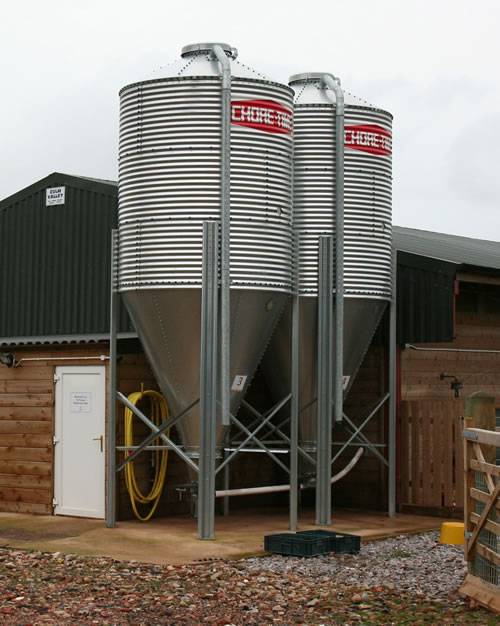
Separation of the feed in the bin can lead to the heavy limestone fraction and / or the larger particles of the diet separating from the lighter ones. The feed in the bin tends to form a funnel as it leaves the bin and this may exacerbate the problem of separation. The fraction of the diet that may be clinging to the sides of the bin may be held back to the extent that it all suddenly leaves the bin in one ’whoosh’. You may say, "so what, the chain feeder will mix it all up again" and this is partially true. However, if you took a sample of feed from the hopper at that time, it would be unlikely to be representative of the whole delivery. When you came to negotiate with your feed compounder, he would be certain to use this as a counter argument to your claim. An unrepresentative feed sample is of little value to you if you are seeking financial recompense for a problem that has been feed related.
If there is a possibility that the feed quality is suspect, the sooner that the hens are given a fresh delivery of feed the better. Feed compounders usually have a lorry that is capable of sucking out the suspect feed from a bin and it is sensible to request this service.
It is infinitely preferable to have two feed bins on your farm rather than just one. This means that each bin can be emptied before being filled again and this overcomes some but not all of the risks of an uneven feed quality being offered to the hens, because of feed separation.
The mill will have kept a sample of the feed delivery. The driver usually will have left a sample on the farm at the time of the delivery. You will have taken your representative sample, so what happens then? You send a sample of feed with a letter detailing the analyses that are needed to a specialist firm that does feed analyses. This sample will have been taken from your plastic bucket. You will have mixed the contents of the bucket thoroughly and then filled a plastic sample bag with a proportion of the feed. Bags with a space on them for writing are sensible. The delivery date and code and feed identification will have been written onto the bag. Keep the remainder of the feed in a cool place, in case further analyses are needed. The other sample is useful in case comparative analyses are also necessary.
So what analyses do you request? Some analyses are expensive and others are not. The cheap ones are quite useful and are done by a technique that is commonly known as NIR (near infrared).
NIR. This can give a fairly accurate estimation of the Metabolisable Energy of the feed. You therefore request the following analyses by NIR: Crude Protein; Oil; Starch; Sugar. In addition a moisture analysis is essential. From the results of these analyses, the analyst will calculate for you the Metabolisable Energy. Typically the analyses on an as received on the farm basis would be about: Crude Protein in the 15 – 17% range. Oil (B) say 3 – 4%. Starch about 3.4%. Sugar about 34%. Metabolisable Energy of a medium energy feed, would typically be about 11.5 MJ/kg. The information that you have from these analyses is of some help. (A lower ME would imply that the hens would have to eat more feed to satisfy their requirement for energy. An artificially high ME may mean that the hens feed intake fell to the point where they may have been unable to ingest sufficient or a balanced range of nutrients). Even so, you should normally request some further analyses. They are:
Manganese. This tells you if the mineral and vitamin mix had been added successfully. Most of the manganese would have come from the mineral / vitamin mix and you could expect the total manganese concentration to be about 100 ppm.
Sodium. One of the more common mistakes is in the addition of salt and sodium bicarbonate to the feed. A sodium content of about 0.17% would be expected. If it were about 0.12% or lower, it would be surprising if the hens were finding the feed palatable. Egg size may have fallen and feather pecking could be beginning to occur. However, sodium is toxic at high concentrations. A sudden increase in water consumption would be likely if there is too much sodium in the feed.
Calcium. This will give clues on whether the limestone addition was correct and whether the feed is indeed representative of the whole delivery or whether it has separated. Normally the anticipated analysis would be about 4.0%. You have to remember here that the inclusion level of the calcium fraction of the feed is usually about twice the analysed amount. So it is little wonder that separation can occur when a heavy ingredient such as limestone has been added at about 8 – 9% of the total ingredients. (Hens only manage to utilise about just over half of the calcium (limestone) in the feed).
Total Ash. This is predominantly the inorganic part of the feed that can’t be burnt. It is useful as a corroboration of the calcium analysis. The ash content would usually be about 13%.
Crude Fibre. This can give some clues on the quality of the ingredients that are used. An optimal fibre content (say 3.5 - 4.5%) is good for the hens’ digestive system, but if it is high, it is possible that, for example, poor quality cereals or vegetable proteins may have been used.
Essential amino acids. If the crude protein analysis looks low or there has been a marked drop in egg weight or feather pecking has occurred, an analysis of the quality of the protein is helpful. I suggest that you request a quotation of the cost of amino acid analyses. Being certain that the results wou